
Ask ten business leaders what "AI development" means and you'll get ten different answers. Some picture a chatbot. Some picture a data science team building predictive models. Some picture something closer to science fiction than software. That confusion is a real problem, because it leads companies to buy the wrong thing, hire the wrong team, or delay a project that could genuinely change how their business runs.
I've spent over a decade sitting across the table from CTOs trying to sort exactly this out, and the honest answer is that AI development services cover a fairly wide range of work, unified by one idea: building software that learns from data and makes decisions, rather than software that just follows fixed rules. That distinction matters more than any specific technology, and it's the right place to start before deciding whether your business actually needs this or is chasing a trend.
What Are AI Development Services?
AI development services involve designing, building, training, and deploying artificial intelligence systems, such as machine learning models, natural language processing tools, computer vision applications, and AI agents, that are tailored to a company's specific data and business problems. This differs from buying generic AI software, since the system is built around your data rather than someone else's.
The work generally spans four layers. Data engineering turns raw business information into something a model can actually learn from. Model development is where the actual AI logic gets built, whether that's a predictive model, a language model application, or a computer vision system. Integration connects that model into the software your business already runs on, whether that's a CRM, an ERP, or an internal dashboard. And monitoring keeps the system accurate after launch, since AI models can quietly lose accuracy as real-world data shifts.
AI development services can mean very different projects depending on the goal. Building a fraud detection model is a different engagement than building a customer-facing chat assistant, which is different again from deploying computer vision on a manufacturing line. What ties them together is the underlying approach: the system improves or adapts based on data, instead of running the same fixed logic forever.
Types of AI Development Services
AI development services generally fall into a few core categories: machine learning development, generative AI development, AI agent development, natural language processing, and computer vision, with most enterprise projects combining two or more depending on the business problem being solved.
Machine learning development covers predictive models, forecasting, and classification systems trained on historical data, used for things like demand forecasting, credit risk scoring, and predictive maintenance.
Generative AI development covers applications built on large language models, from internal knowledge assistants to content generation tools, usually grounded in company-specific data through retrieval-augmented generation.
AI agent development focuses on systems that take multi-step actions across software tools, rather than simply answering a question or making a single prediction.
Natural language processing powers document analysis, sentiment detection, and intelligent search across large volumes of unstructured text.
Computer vision handles tasks like quality inspection, inventory tracking, and visual monitoring, common in manufacturing and retail.
Why Businesses Need AI Development Services
Businesses need AI development services because generic, off-the-shelf AI tools rarely fit the specific workflows, data structures, and compliance requirements of an established organization, and because building this expertise entirely in-house is a slow, expensive undertaking most companies aren't set up to do alone. A specialized partner closes both gaps at once.
The fit problem shows up constantly. A generic AI tool has to work reasonably well for thousands of different customers, which means it rarely fits any single business precisely. It doesn't know your terminology, your legacy systems, or the specific decision your team is trying to improve. Custom AI development starts from your actual data and workflow, which is why it tends to outperform generic tools on the metrics that actually matter to a specific business.
The expertise problem is just as real. Hiring data engineers, machine learning engineers, and MLOps specialists internally is a significant investment before a single model reaches production. A specialized AI development partner already has that team assembled, along with the experience of what typically breaks when a model meets real business data, something that's hard to learn except by doing it repeatedly across different projects.
Benefits of AI Development Services for Businesses
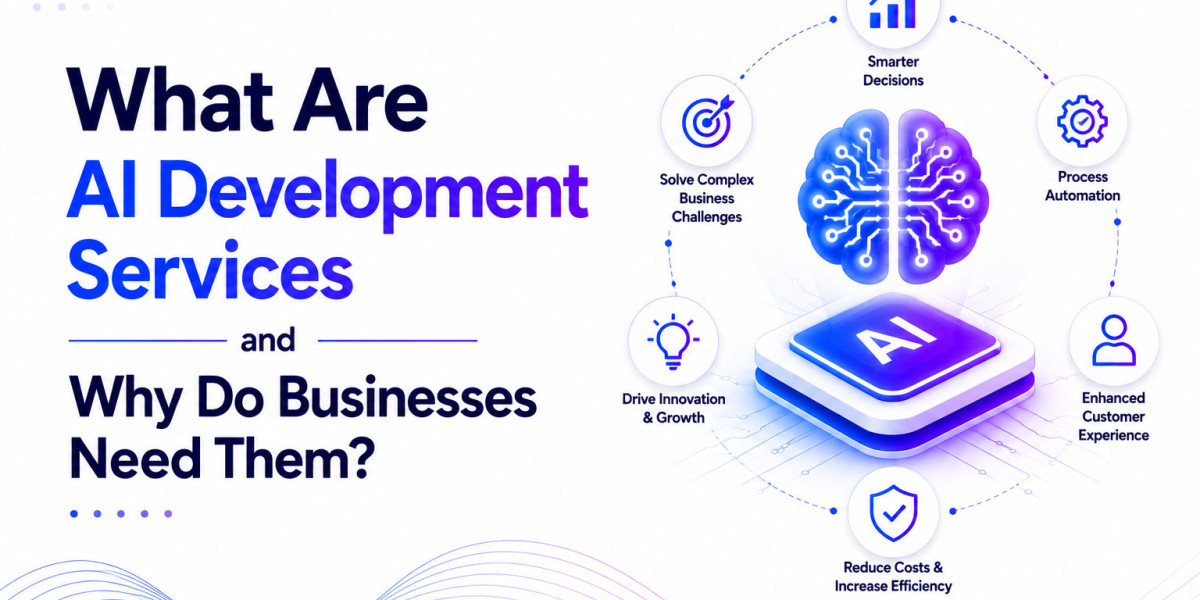
AI development services help businesses automate repetitive workflows, improve forecasting accuracy, reduce operational costs, and make faster, better-informed decisions, with the specific benefits depending on where in the business the AI system gets applied.
Workflow automation removes manual, repetitive tasks like document processing or basic customer support responses, freeing employees for work that requires judgment.
Improved forecasting comes from predictive models that account for more variables and more data than a person can reasonably track manually.
Cost reduction follows from fewer manual errors, less rework, and often the consolidation of multiple point tools into one integrated system.
Faster decision-making happens when AI systems score, classify, or flag things in real time instead of waiting in a manual review queue.
Stronger risk management shows up in fraud detection, compliance monitoring, and quality control systems that catch issues at a scale manual review can't match.
Competitive differentiation comes from AI systems trained on your proprietary data, something competitors using the same generic tools as you can't easily replicate.
AI Development Services vs Off-the-Shelf AI Tools
Off-the-shelf AI tools offer faster deployment and lower upfront cost, while custom AI development services offer better long-term fit, stronger data security, and full ownership of the resulting model. The right choice depends on how specific and complex your business workflows actually are.
| Factor | AI Development Services | Off-the-Shelf AI Tools |
|---|---|---|
| Customization | Built around your exact data and workflows | Limited to the vendor's predefined features |
| Cost structure | Higher upfront, lower long-term | Lower upfront, ongoing licensing fees |
| Data security | Full control over data and infrastructure | Data often processed on shared vendor infrastructure |
| Ownership | You own the model and its outputs | Vendor typically owns the underlying model |
| Integration | Built to fit legacy and existing systems | May require workarounds for older systems |
| Best fit | Complex, specific, or regulated workflows | Simple, generic, common use cases |
For a straightforward, common problem, an off-the-shelf tool is often the faster and cheaper path. For anything involving legacy systems, strict compliance requirements, or a genuinely specific workflow, custom AI development services tend to earn back their higher upfront cost through better long-term fit.
How the AI Development Process Works
The AI development process generally follows discovery, data assessment, model selection, development, integration, testing, deployment, and ongoing monitoring, with most of the real project time going into the data-related stages rather than building the model itself.
- Discovery — Defining the specific business outcome the system needs to improve, not a vague goal like "add AI somewhere."
- Data Assessment — Auditing what data exists, its quality, and where the gaps are before committing to an approach.
- Model Selection — Choosing the right technique, whether that's a predictive model, a generative AI application, or a computer vision system, based on the problem and available data.
- Development — Building the model and the application logic around it.
- Integration — Connecting the system to existing business software without disrupting current operations.
- Testing — Checking accuracy, bias, and edge-case behavior before production data touches the system.
- Deployment — Rolling out in a controlled environment, often to one team before a full launch.
- Monitoring — Tracking real-world performance and watching for drift as data patterns shift over time.
Common Challenges Businesses Face with AI Development
The most common challenges in enterprise AI development are poor data quality, integration friction with legacy systems, and low employee trust in AI-driven decisions. Addressing these before development starts saves significantly more time and cost than fixing them after launch.
Poor data quality undermines even a well-designed model. Incomplete, inconsistent, or siloed data limits accuracy no matter how sophisticated the underlying approach is, which is why a proper data audit needs to happen before training, not during it.
Integration friction shows up when legacy systems weren't built with modern APIs in mind. Middleware layers and a phased integration plan usually solve this without requiring a full systems overhaul.
Low trust in AI output stalls adoption even when a system technically works well. Employees who don't understand why a model made a specific recommendation tend to fall back on their own judgment. Building explainability into the system and involving end users early in the rollout addresses this far more reliably than accuracy improvements alone.
How to Choose an AI Development Services Partner
The right AI development partner has verifiable experience with projects similar in scope to yours, a dedicated data science and engineering team, clear data ownership terms, and a defined plan for monitoring and support after launch. Evaluating a partner deserves as much scrutiny as the technical decisions themselves.
Checklist for evaluating a partner:
- Proven experience with production AI systems, not just proof-of-concept work
- Portfolio examples matching your industry's data and regulatory requirements
- A dedicated AI/ML team, not just generalist software developers
- Transparent technology stack and architecture decisions
- Clear terms on data ownership and model portability
- A concrete plan for post-launch monitoring and retraining
- Direct, specific communication throughout the evaluation process
Future of AI Development Services
AI development services are shifting toward agentic AI, multimodal systems, private LLMs, and stronger AI governance requirements, as businesses move from experimenting with individual AI tools toward deploying connected systems that handle full workflows with human oversight built in.
Agentic AI and autonomous AI agents represent the clearest shift, moving from AI that answers a question or makes a prediction toward AI that completes multi-step tasks across systems on its own. Multimodal AI is expanding what these systems can process, handling text, images, and documents together rather than one data type at a time, which matters in industries where visual data carries as much weight as written or numerical data. Private LLMs are gaining adoption among enterprises that want generative AI capability without routing sensitive data through public APIs, and AI governance, covering explainability and bias monitoring, is becoming a standard part of enterprise AI procurement rather than an afterthought.
Conclusion
AI development services exist because generic tools and generic teams rarely produce AI systems that fit a specific business well. The companies seeing real returns from AI aren't the ones who bought the flashiest tool. They're the ones who invested in systems built around their actual data, their actual workflows, and their actual compliance requirements, with a partner who's done this enough times to know where the risk usually hides.
If you're trying to figure out whether your business is ready for an AI development project, or which type of AI system actually fits the problem you're trying to solve, it's worth a direct conversation before committing budget to a build.
Frequently Asked Questions
What are AI development services?
AI development services involve designing, building, training, and deploying AI systems, such as machine learning models, generative AI applications, and AI agents, tailored to a specific company's data and business problems.
What is the difference between AI development and AI integration?
AI development involves building the underlying model or system from the ground up, while AI integration focuses on connecting an existing AI capability, whether built in-house or licensed, into your current software and workflows.
How much do AI development services typically cost?
Cost depends on the scope, data complexity, and type of AI system involved. A scoped pilot project, such as a single predictive model or chat assistant, costs significantly less than a full enterprise-wide deployment.
How long does an AI development project take?
Timelines vary based on data readiness and integration complexity. A focused pilot can launch in a few months, while broader, enterprise-wide rollouts typically take longer.
Do we need a large amount of data to start an AI project?
Not necessarily a large amount, but the data needs to be relevant and reasonably clean. A proper data assessment early in the process determines what's realistic given what you currently have.
Can AI development services integrate with our existing software?
Yes. Most AI development projects are built with integration in mind, connecting to CRMs, ERPs, and other existing systems through APIs or middleware, rather than requiring a full software replacement.
Is custom AI development more secure than off-the-shelf AI tools?
Generally, yes. Custom AI development gives your business control over where data is stored and processed, which matters significantly for industries under strict compliance requirements.
Should smaller businesses invest in AI development services?
Yes, if there's a specific, well-defined problem worth solving. It doesn't require an enterprise-scale budget to start; many smaller businesses begin with a single, scoped AI project and expand from there.







