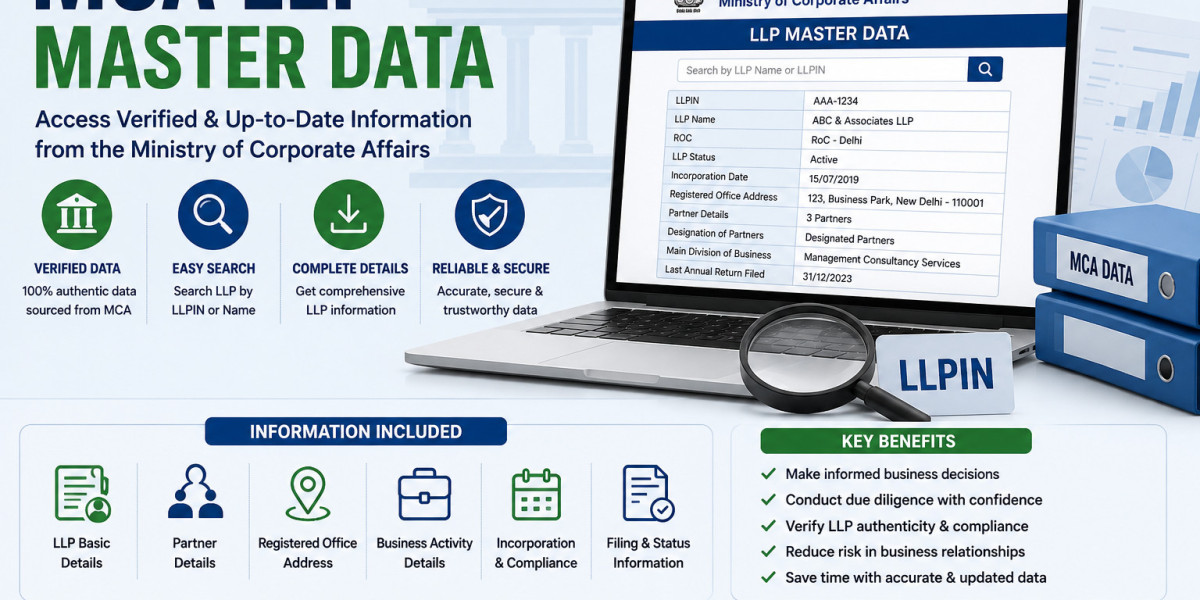

For banks, NBFCs, fintech companies, lenders, insurers, and enterprises, understanding the legal and financial profile of a business is essential before entering into a commercial or credit relationship. When the entity is a Limited Liability Partnership (LLP), LLP MCA Master Data provides an important starting point for verifying its corporate identity and registered information.
Maintained through India's Ministry of Corporate Affairs (MCA) system, LLP-related master data can help organizations verify an LLP's basic details, understand its registered status, identify designated partners, and support broader due diligence.
For financial professionals, this information can contribute to better onboarding, counterparty assessment, supplier verification, credit underwriting, and compliance processes.
What Is LLP MCA Master Data?
LLP MCA Master Data refers to key information about a Limited Liability Partnership available through the MCA's corporate records and related services.
An LLP is a separate legal entity that combines elements of a partnership structure with limited liability. Like companies, LLPs are required to comply with applicable corporate and regulatory requirements.
Depending on the information available, an LLP master data record may include:
- LLP name
- LLP Identification Number (LLPIN)
- Date of incorporation
- Registered office address
- LLP status
- Business or activity information
- Contribution-related information
- Designated partner details
- Other registered information
This information can help establish whether an LLP exists and provide a basic view of its registered corporate identity.
Why Is LLP MCA Master Data Important?
Master data is particularly useful when an organization needs to verify a business before making a financial or commercial decision.
Supporting Business Verification
Suppose a company is considering a new LLP as a supplier. Instead of relying only on documents supplied by the vendor, the procurement team can cross-check the LLP's registered information against MCA records.
This can help identify differences in legal name, registration details, or status.
Supporting Credit Decisions
Lenders and financial institutions can use LLP information as part of a broader borrower assessment.
Master data does not establish whether an LLP is creditworthy by itself, but it can provide a verified corporate foundation for further financial analysis.
Improving Compliance
Accurate entity identification is important for customer onboarding, KYC, vendor verification, and internal compliance processes.
MCA information can serve as one source for validating the legal identity of an LLP.
Key Information Available Through LLP Master Data
LLPIN
The LLP Identification Number is a unique identifier assigned to an LLP. It can be used to distinguish the LLP from other entities with similar names.
LLP Name
The registered legal name helps organizations ensure that contracts, invoices, onboarding records, and financial documentation refer to the correct entity.
Date of Incorporation
The incorporation date provides insight into how long the legal entity has existed.
However, the age of an LLP should not be interpreted as a measure of financial strength without additional analysis.
Registered Office
The registered address can support identity verification and document checks.
For lenders and enterprises, differences between the registered address and information provided during onboarding may warrant further review.
LLP Status
The recorded status can indicate whether the LLP is active or has another registered status.
This is important when verifying whether an entity remains suitable for a proposed transaction or business relationship.
Designated Partners
Designated partners play an important role in the management and compliance of an LLP. Their details can help organizations understand the registered management structure.
How to Check LLP MCA Master Data
Organizations can generally access LLP-related information through MCA services or authorized business-information platforms.
Step 1: Identify the LLP
Search using the LLP's legal name or LLPIN, depending on the available search facility.
Step 2: Review the Registered Information
Check the LLP name, incorporation details, registered office, status, and other available information.
Step 3: Verify Partner Information
Review available designated partner information where relevant to the purpose of the assessment.
Step 4: Compare With Submitted Documents
Compare the MCA information with contracts, GST records, invoices, registration documents, and other information supplied by the counterparty.
Step 5: Conduct Further Due Diligence
For important financial decisions, MCA master data should be supplemented with financial, legal, credit, ownership, and commercial information.
LLP MCA Master Data for Banks and NBFCs
Banks and NBFCs can use LLP information during borrower onboarding and credit assessment.
For example, consider an LLP applying for a business loan. The lender can first verify the LLPIN, legal name, incorporation date, status, registered office, and designated partners.
The lender can then combine this information with financial statements, banking history, credit information, existing liabilities, and repayment capacity.
This layered approach provides a stronger basis for credit decisions than relying on a single information source.
LLP MCA Master Data for Fintech Companies
Fintech companies often need to verify large numbers of businesses quickly. Using structured corporate information can improve onboarding efficiency and reduce manual verification.
For higher-risk customers, MCA data can be combined with automated screening, financial analysis, ownership checks, and transaction-level risk indicators.
This can help fintech companies balance fast onboarding with appropriate risk controls.
LLP MCA Master Data for Supplier Due Diligence
Enterprises can also use LLP information when evaluating suppliers and business partners.
For example, before signing a long-term contract with an LLP, a company may verify:
- Legal existence
- LLP status
- Registered address
- Designated partners
- Business activity
- Incorporation details
Additional supplier due diligence can then examine financial stability, litigation, credit exposure, market reputation, and operational capacity.
Limitations of LLP MCA Master Data
While useful, MCA master data should not be treated as a complete risk assessment.
It may not provide a full picture of:
- Current financial health
- Payment behavior
- Creditworthiness
- Beneficial ownership in every context
- Commercial reputation
- Operational capability
- Future business performance
Therefore, financial institutions and enterprises should use MCA information as one component of a broader due diligence process.
How MNS Credit Management Group Can Help
MNS Credit Management Group provides business intelligence and risk management solutions that can support organizations in evaluating LLPs and other business entities.
Its services include MCA Company Search, MCA Master Data, Business Information Reports, Due Diligence Reports, Credit Opinion Reports, Supplier Verification, Debt Collection, Accounts Receivable Management, and credit risk solutions.
By combining corporate information with financial and commercial intelligence, MNS helps organizations make more informed decisions when dealing with borrowers, suppliers, customers, and other counterparties.
Conclusion
LLP MCA Master Data is a valuable starting point for verifying the legal identity and registered information of a Limited Liability Partnership. For banks, NBFCs, fintech companies, lenders, insurers, and enterprises, it can support business verification, credit assessment, supplier onboarding, compliance, and counterparty risk management.
However, MCA information should not be viewed in isolation. Combining LLP master data with financial analysis, credit information, legal checks, ownership research, and ongoing monitoring provides a more complete picture of business risk.
For organizations making high-value financial or commercial decisions, this structured approach can improve accuracy, reduce avoidable risks, and support stronger long-term business relationships.
FAQs About LLP MCA Master Data
What is LLP MCA Master Data?
LLP MCA Master Data is key registered information about a Limited Liability Partnership available through the Ministry of Corporate Affairs system and related services.
What information can be checked using LLP master data?
Depending on the available record, users may find the LLP name, LLPIN, incorporation date, registered office, status, designated partner information, and other registered details.
How can LLP MCA Master Data help lenders?
It helps lenders verify the legal identity and registered status of an LLP before combining that information with financial, credit, legal, and repayment data for a broader credit assessment.
Is LLP MCA Master Data enough for due diligence?
No. It is an important verification source but does not provide a complete assessment of financial strength, creditworthiness, litigation, reputation, or operational capability.
What is the difference between LLPIN and LLP MCA Master Data?
LLPIN is the unique identification number assigned to an LLP, while LLP MCA Master Data refers to the broader set of registered information associated with that LLP.