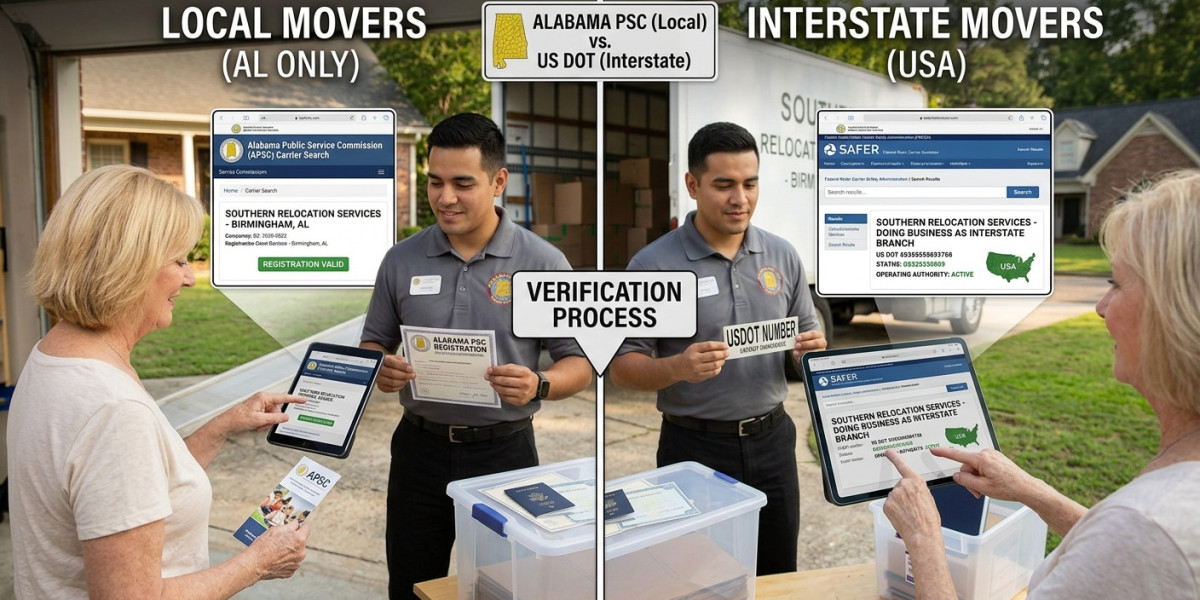

Hiring a mover in Alabama can seem straightforward until you realize that different rules may apply depending on where your belongings are going. A company moving your household goods from Birmingham to Montgomery isn't necessarily regulated in the same way as a company transporting them from Birmingham to Nashville.
That distinction matters when you're checking licenses, registration, insurance, and operating authority.
Whether you're planning a local move within Alabama or crossing state lines, you shouldn't rely solely on reviews, a professional website, or a salesperson saying the business is “licensed and insured.” To Verify a moving company in Alabama, you need to know which credentials apply to your particular move and confirm them independently.
What Is the Difference Between a Local and Interstate Move?
A local or intrastate Alabama move generally involves transportation between points within the state. Examples include Huntsville to Birmingham, Montgomery to Mobile, or Tuscaloosa to Auburn.
An interstate move involves transportation across state lines, such as Alabama to Florida, Georgia, Tennessee, Mississippi, or another state.
There is an important nuance: a household-goods move between two locations in the same state can still qualify as interstate transportation in certain circumstances, including when the shipment travels through another state.
Knowing how your shipment will be transported helps determine which regulatory requirements apply.
Who Regulates Local Movers in Alabama?
For compensated household-goods transportation within Alabama, the Alabama Public Service Commission (APSC) is a key regulator.
The APSC's Motor Carrier Services Section states that intrastate authority is required for transporting property, including household goods, for compensation between points within Alabama unless an exemption applies.
This means that when you're hiring a company for an intrastate Alabama move, checking applicable APSC authority should be one of your first verification steps.
Don't simply ask the mover whether it has a license.
Ask for its legal business information and independently confirm that its authority corresponds with the company you're considering.
Who Regulates Interstate Movers in Alabama?
When your household goods cross state lines, federal requirements become important.
Interstate household-goods movers must be registered with the Federal Motor Carrier Safety Administration (FMCSA) and have a U.S. DOT number.
FMCSA provides a mover-search system that consumers can use to review information including registration status, headquarters, contact information, business type, complaint information, and safety information.
However, finding a company in the federal database doesn't complete your investigation.
A mover can be registered without being authorized to transport household goods. Make sure the interstate carrier you're considering actually has the appropriate household-goods authority.
Local vs. Interstate Movers: What Should You Verify?
The biggest difference is where you perform the regulatory check.
For an Alabama intrastate move, verify applicable state authority through the APSC.
For an interstate move, verify the company through FMCSA and confirm its federal household-goods authority.
But both types of moves require additional due diligence.
You should still investigate the company's identity, insurance, estimates, contracts, payment requirements, customer complaints, and whether you're dealing with an actual carrier or broker.
Regulatory authority is a starting point—not the entire verification process.
Check the Company's Exact Business Identity
One of the most important steps when you verify a moving company in Alabama is making sure you're researching the correct business.
Write down the mover's:
- Legal business name
- Trade name
- Physical address
- Telephone number
- Website
- Alabama authority information, if applicable
- USDOT number for interstate operations
- MC information when applicable
Compare those details with independent regulatory information.
A company can legitimately operate under a trade name that differs from its legal name. But you should be able to establish the connection.
Be cautious when company names, addresses, telephone numbers, contracts, and payment recipients don't match and nobody can clearly explain why.
Verify Insurance Before Booking
Insurance requirements are another reason state-level verification matters.
The APSC currently requires regulated persons to maintain proof of liability insurance. Regulated property and household-goods carriers must also maintain proof of cargo insurance.
Don't interpret the phrase “fully insured” as a complete explanation of how your belongings are protected.
Ask what happens if an item is damaged or lost. Understand the mover's liability terms and claims procedure before moving day.
For interstate moves, FMCSA also advises customers to confirm that the mover has appropriate insurance information on file.
Are You Hiring a Mover or Moving Broker?
This question is essential for both local and interstate customers.
A mover or carrier physically transports your household goods.
A moving broker arranges transportation through another company.
For intrastate Alabama operations, the APSC states that a broker license is required when someone arranges compensated transportation of property within the state.
For interstate moves, household-goods brokers must be registered with FMCSA. They don't physically transport household goods and are required to use registered interstate movers.
Current federal requirements also require brokers to clearly disclose their broker status in advertising and provide consumers with specified information.
Ask directly:
“Will your company physically transport my belongings, or will another mover perform the job?”
Using a broker isn't automatically a problem. The problem is booking without realizing you're dealing with one.
Why You Should Verify Both the Broker and Carrier
If you're booking an interstate move through a broker, your verification shouldn't stop after checking the broker.
Eventually, another company may be assigned to physically transport your belongings.
Verify that carrier too.
Confirm its identity, federal registration, household-goods authority, and available complaint information before releasing your possessions.
This is particularly important because the business selling you the move and the company arriving with the truck may be different.
Consumer-awareness brands such as Moving Scam Stories help consumers become familiar with recurring moving-fraud patterns, including misleading company identities, broker confusion, unusually low estimates, unexpected carriers, and last-minute price disputes. Understanding these patterns can complement official credential checks when you're evaluating who should handle your belongings.
Compare Several Written Estimates
Whether your move is local or interstate, don't hire a company solely because it offers the lowest price.
Get multiple written estimates.
For interstate moves, FMCSA recommends obtaining estimates from at least three movers or brokers and comparing both pricing and services.
Make sure every company receives accurate information about what you're moving.
Tell them about furniture, appliances, boxes, oversized items, stairs, elevators, long carries, packing requirements, storage needs, and difficult truck access where applicable.
If several estimates are reasonably close and one is dramatically cheaper, investigate the difference.
A low estimate isn't automatically fraudulent, but an unrealistic price can be used to secure a booking before additional charges appear.
Understand Interstate Moving Estimates
Federal requirements make understanding your estimate particularly important for interstate transportation.
A rate quote isn't necessarily the same thing as a formal written estimate.
Interstate movers must provide written estimates of applicable charges. Estimates should be based on an actual or virtual inspection of the household goods.
You should also know whether you're receiving a binding or non-binding estimate.
A binding estimate generally establishes what you will owe for the goods and services included in that estimate, subject to applicable changes.
A non-binding estimate isn't a guarantee of the final amount. Final charges can depend on factors such as actual shipment weight and services performed.
Research Complaint Patterns Before Hiring
Licensing and authorization don't tell you everything about a company's customer service history.
Research complaints and reviews before booking.
For interstate movers and brokers, FMCSA's mover-search resources provide complaint information that can be included in your research.
When reading online reviews, look beyond the star rating.
Pay attention to recurring complaints involving sudden price increases, deposit disputes, delayed deliveries, damaged or missing property, unexpected movers, unclear broker relationships, or belongings being withheld during payment disputes.
One complaint doesn't prove fraud.
Repeated reports of similar practices deserve closer attention.
Watch for Large Deposits and Payment Pressure
Before sending money, understand exactly what you're paying for.
Ask whether a deposit is refundable, when cancellation fees apply, when the remaining balance becomes due, and which payment methods are accepted.
Be cautious if a company demands a large upfront payment while creating artificial urgency.
Statements such as “You must pay immediately or lose this price” shouldn't prevent you from completing your verification.
A mover should be evaluated before it receives your money—not afterward.
Never Sign Blank Moving Documents
This rule applies regardless of whether you're moving across Birmingham or across the country.
Don't sign blank or substantially incomplete paperwork.
Review your estimate, contract, inventory, bill of lading where applicable, and other important documents before signing.
Check the company name, services, prices, dates, addresses, and payment conditions.
If a salesperson made an important promise verbally, make sure the written terms are consistent with what you were told.
Keep copies of every document you sign.
Verify Who Arrives on Moving Day
Your verification process shouldn't end when you make the reservation.
When the truck arrives, confirm who is actually taking possession of your household goods.
If you hired a carrier directly, the business performing the move should correspond with the company you expected.
If you hired a broker, a different carrier may legitimately arrive—but you should know who that carrier is.
For an interstate move, verify the assigned motor carrier through federal records before allowing loading to begin.
An unexplained company substitution deserves investigation.
Local Alabama Mover Red Flags
For an intrastate move, be cautious when a company can't provide verifiable business information or appropriate Alabama authority and cannot explain an applicable exemption.
Other warning signs include vague contracts, extremely low prices, unclear insurance information, pressure to make immediate payments, and incomplete paperwork.
Also investigate inconsistent company names or contact information.
No single irregularity automatically establishes that a business is fraudulent, but several inconsistencies can indicate unnecessary risk.
Interstate Alabama Mover Red Flags
For interstate moves, watch for additional warning signs.
Be cautious if the company doesn't display or provide a USDOT number, can't be found in federal mover records, lacks household-goods authority, or misrepresents whether it is a carrier or broker.
Other concerns include brokers that won't identify the movers they use, missing required consumer information, large deposit requests, and dramatic price changes.
FMCSA requires interstate movers and brokers to provide consumers with important information, including access to Your Rights and Responsibilities When You Move.
If you're not receiving required documentation, ask why.
Quick Checklist to Verify a Moving Company in Alabama
Before hiring either a local or interstate mover, confirm:
- Whether the move is intrastate or interstate
- Applicable APSC authority for an Alabama intrastate move
- Federal registration and household-goods authority for an interstate carrier
- The company's legal identity and contact information
- Applicable insurance information
- Whether the business is a mover or broker
- The identity of the actual carrier when using a broker
- Multiple written estimates
- Complaint and review patterns
- Contract, deposit, and payment terms
Complete these checks before your moving date whenever possible.
What Should You Do If You Can't Verify the Company?
Don't send money simply because your moving date is approaching.
Ask the company for clarification and independently check any information it provides.
If significant inconsistencies remain, consider another mover.
Keep estimates, contracts, emails, text messages, advertisements, screenshots, and payment records if you believe you've encountered questionable activity.
Alabama intrastate regulatory concerns may fall under appropriate Alabama authorities, while interstate moving complaints can be reported through federal transportation complaint channels.
Final Thoughts
The difference between local and interstate movers in Alabama isn't simply how far the truck travels. Different regulatory frameworks can determine what credentials you should verify.
For a compensated intrastate household-goods move, check applicable Alabama Public Service Commission authority. For interstate transportation, verify the mover through FMCSA and make sure a carrier is actually authorized to transport household goods.
But don't stop with licensing.
To properly verify a moving company in Alabama, confirm its identity, insurance information, mover-or-broker status, estimates, complaint patterns, contracts, and payment terms.
If a broker is involved, verify the carrier too.
The safest mover isn't necessarily the company with the cheapest estimate or best-looking website. It's the company whose identity, authority, pricing, and role in your move can be clearly understood and independently verified before your belongings leave your home.
Frequently Asked Questions
Who Regulates Local Moving Companies in Alabama?
The Alabama Public Service Commission regulates motor carriers subject to Alabama's applicable motor-carrier laws. Compensated intrastate household-goods transportation generally requires appropriate APSC authority unless an exemption applies.
Who Regulates Interstate Movers Operating From Alabama?
Interstate household-goods movers are subject to Federal Motor Carrier Safety Administration requirements and must be registered with FMCSA. Carriers should also have appropriate authority to transport household goods.
How Do I Verify a Moving Company in Alabama?
Determine whether your move is intrastate or interstate, then check applicable APSC or FMCSA credentials. Also verify the company's identity, insurance information, estimates, broker status, contracts, and complaint patterns.
Does a USDOT Number Mean an Interstate Mover Is Authorized?
Not necessarily. A company can be registered with FMCSA without being authorized to transport household goods. Check its actual household-goods authority.
Should I Verify a Carrier If I Hire a Moving Broker?
Yes. Verify the broker and then independently check the motor carrier assigned to physically transport your household goods.