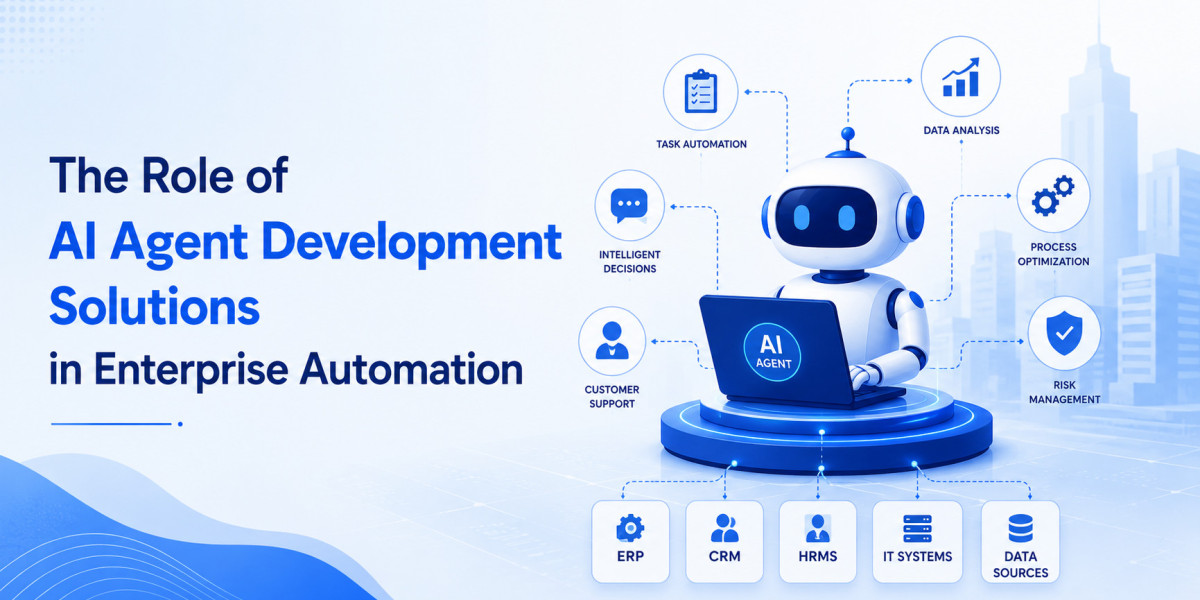

Something fundamental is shifting in how enterprises think about automation. The first wave — rule-based bots that followed scripts, triggered workflows, and processed structured data — delivered real efficiency gains. But it also exposed a ceiling. The moment a process required judgment, context, or the ability to handle an unexpected input, the bots fell apart. Humans had to step back in. The automation remained fragile, narrow, and perpetually dependent on exceptions being handled manually. That limitation isn't a software problem. It's an architectural problem. And AI agents are the architecture that solves it.
Unlike traditional automation tools, AI agents don't just execute instructions. They perceive their environment, reason about goals, take sequences of actions, and adapt when outcomes deviate from expectations. They can browse the web, query databases, write and execute code, communicate with external APIs, and hand off tasks to other agents — all in service of a higher-level objective defined by a human. For enterprise operations, this represents a qualitative leap, not just a quantitative one. The difference between automating a task and deploying an AI agent to own an entire workflow is the difference between a calculator and a collaborator. AI Agent Development is the discipline that makes that collaborator real, reliable, and deeply integrated into how your business operates.
Why Enterprises Are Moving Past RPA and Into Agent-Based Automation
Robotic Process Automation had its moment — and for many organizations, it still has a place. But its fundamental constraint is that it requires processes to be perfectly defined, perfectly consistent, and perfectly structured. Real enterprise operations are none of those things. Vendors send invoices in seventeen different formats. Customer queries arrive with missing information. Regulatory environments shift. Exceptions are not edge cases — they're daily realities. RPA handles the straightforward; it breaks on the complex. And in most enterprises, the complex is where the most value lives.
AI agents change the calculus entirely. They bring reasoning capability to the automation layer — the ability to interpret ambiguous inputs, make decisions based on context, escalate appropriately when a situation exceeds defined parameters, and learn from outcomes over time. An enterprise deploying agents isn't automating tasks; it's creating a workforce of tireless, context-aware digital workers that operate across systems without needing bespoke integrations for every use case. The firms that have already made this transition aren't talking about cost savings alone. They're talking about entirely new operational capabilities — things their business literally couldn't do before, because no human team could execute them at the required speed and scale.
- AI agents handle unstructured inputs — emails, PDFs, voice notes, images — that RPA bots cannot process without rigid pre-formatting
- Agent-based systems can operate across multiple software environments simultaneously, eliminating the siloed automation problem
- Agents escalate intelligently, routing complex cases to humans with full context rather than failing silently or generating errors
- They improve over time through feedback loops — outcomes inform future decision-making without requiring manual rule updates
- Multi-agent architectures allow parallel task execution across entire workflows, not just isolated process steps
AI Voice Agents: Redefining the Customer-Facing Frontline
The customer interaction layer is where enterprises feel the automation pressure most acutely — and where the cost of getting it wrong is highest. Call center operations are expensive, inconsistent, and difficult to scale. Peak periods overwhelm capacity. Off-hours leave customers without support. Training costs are high, turnover is higher, and quality varies with individual agent performance. Traditional IVR systems helped manage volume but frustrated customers with rigid menus and dead-end experiences. Something fundamentally better was needed.
AI Voice Agent Development delivers that something better. Modern voice agents don't just respond to keywords — they understand intent, maintain conversational context across multi-turn dialogues, handle interruptions and corrections naturally, and execute backend actions in real time. A voice agent can verify a customer's identity, retrieve their account history, resolve a billing dispute, process a return, and confirm the resolution — all within a single phone call, without human involvement. The experience, when built well, doesn't feel like a bot. It feels like a competent, patient, always-available representative who genuinely knows your account. For enterprises operating at scale, that's not a feature. That's a structural competitive advantage.
- Natural language understanding handles regional accents, colloquialisms, and incomplete sentences without requiring scripted phrasing from callers
- Real-time CRM and ERP integration allows voice agents to access and update customer records during live conversations
- Sentiment detection triggers automatic escalation to human agents when frustration or urgency is detected
- Multilingual voice agent deployment enables global customer support without proportional headcount scaling
- Conversation analytics from every voice interaction feed into product, operations, and service improvement decisions at the enterprise level
AI Sales Agents: Turning Pipeline Activity into a 24/7 Operation
Sales is one of the most human-intensive functions in any enterprise — and counterintuitively, one of the most ripe for intelligent automation. Not because the human relationship doesn't matter (it absolutely does, especially in complex B2B deals), but because the majority of sales activity isn't relationship-building. It's prospecting, qualifying, following up, scheduling, nurturing, and responding to inbound interest — all of which happen at a cadence and volume that no human sales team can sustain without enormous resources. AI Sales Agent Development addresses this reality head-on, creating digital agents that work the pipeline continuously, so your human sellers can focus on the conversations that actually require them.
What makes AI sales agents genuinely powerful is their ability to personalize at scale. They don't send the same follow-up to every lead. They analyze prospect behavior — email opens, content consumed, website pages visited, previous interactions — and craft outreach that reflects genuine awareness of where that prospect is in their buying journey. They respond to inbound inquiries within seconds, not hours. They qualify leads against defined criteria and route high-value opportunities to human reps with a full context briefing. The pipeline never sleeps, and the qualification work that used to consume your best reps' mornings gets done before they log in.
- Automated outbound prospecting sequences personalized to industry, role, and behavioral signals — not generic templates
- Inbound lead response within seconds of form submission or website inquiry, dramatically improving contact rates
- Qualification conversations via email, chat, or voice that assess fit before human rep time is invested
- CRM enrichment with data gathered during agent interactions, ensuring human reps have complete context before every call
- Pipeline analytics that surface which outreach sequences, messages, and timing patterns drive the highest conversion rates
Enterprise AI Agent Development: Building for Scale, Security, and Integration
Deploying an AI agent for a single workflow is a proof of concept. Building an agent architecture that operates reliably across an entire enterprise — integrated with dozens of systems, governed by security and compliance requirements, observable in real time, and capable of expanding as new use cases emerge — is a fundamentally different engineering challenge. Enterprise AI Agent Development isn't just about building a capable agent. It's about building the infrastructure that makes agents trustworthy, auditable, and genuinely embedded in how the business operates.
This is where many enterprises hit friction when they try to build internally. The AI capability might be strong. But the surrounding architecture — the orchestration layer, the observability tooling, the access control framework, the escalation logic, the human-in-the-loop design — requires a different set of engineering disciplines than most internal IT teams have cultivated. That's not a criticism; it's simply a reflection of how new this space is. The teams that have built enterprise-grade agent systems before bring pattern knowledge that compresses the build timeline and prevents the costly architectural mistakes that only reveal themselves at production scale.
- Role-based access control ensuring agents only interact with data and systems appropriate to their defined function
- Full audit trails of agent decision-making, enabling compliance review and error investigation without black-box opacity
- Human-in-the-loop design at appropriate checkpoints — agents act autonomously within defined bounds, escalate outside them
- Agent orchestration layers that coordinate multi-agent workflows without race conditions, redundant actions, or task conflicts
- Observability dashboards that surface agent performance, error rates, and outcome metrics in real time for operations teams
Why India Has Become the Go-To Destination for AI Agent Expertise
The global demand for AI agent development capability has outpaced supply almost everywhere — except India, which has responded to the AI wave the same way it responded to the cloud, mobile, and enterprise software waves before it: by building deep technical expertise at scale, faster than any other market. The concentration of AI engineers, LLM specialists, and agent framework developers in Indian technology hubs is now substantial enough that accessing it isn't an offshore compromise — it's a deliberate strategic advantage. When enterprises engage AI agent development services in India , they're plugging into an ecosystem that has been building production AI systems for global clients long enough to have learned from real deployments, not just academic projects.
The cost dimension is real but secondary. What drives serious enterprises to engage an AI agent development company in India isn't the rate card. It's the ability to find teams that have already built voice agents, sales agents, enterprise orchestration systems, and multi-agent workflows for clients in regulated industries — and can demonstrate that experience with specifics, not generalities. That depth of practical knowledge, available at a fraction of what equivalent Western firms charge, represents exactly the kind of asymmetric advantage that smart business owners are wired to recognize and exploit.
- India's AI engineer talent pool includes deep specialization in LLM fine-tuning, agent framework development (LangChain, AutoGen, CrewAI), and multi-modal AI systems
- Proven delivery track record across regulated industries — financial services, healthcare, legal, and enterprise SaaS — where agent reliability and compliance matter most
- Time zone coverage enables near-continuous development cycles for enterprises with aggressive deployment timelines
- Indian development firms offer flexible engagement structures: fixed-scope builds, dedicated agent teams, or staff augmentation for internal AI initiatives
- Post-deployment monitoring, retraining, and agent optimization services ensure systems improve over time rather than degrading as conditions change
The Decision to Hire AI Agent Developers: What It Actually Involves
The business case for AI agents is increasingly clear. The harder question for most enterprise leaders is structural: do we build this capability internally, or do we partner with a specialist firm? Both paths have legitimate arguments. Internal teams carry institutional knowledge and stay permanently embedded. But in a field evolving as rapidly as AI agent development, internal teams also risk falling behind the frontier unless agent development is genuinely a core focus — not a side project alongside the existing IT roadmap.
For most enterprises, the decision to Hire AI Agent Developers through a specialist partner — whether for a specific initiative or as an ongoing embedded capability — offers the faster path to production-grade outcomes. The key is treating the engagement as a knowledge-transfer relationship, not just a delivery arrangement. The best partnerships end with your internal team understanding the architecture, able to extend it, and no longer dependent on the partner for routine changes. That's the engagement model worth seeking — one where the partner's goal is to make themselves partially unnecessary over time, because their value shifts from building to advising as your team's capability grows.
- Define success metrics before the engagement begins — agent accuracy rates, task completion rates, escalation frequency, and business outcome impact
- Require architecture documentation as a deliverable, not an afterthought — you should own full understanding of what's been built
- Structure engagements in phases with clear handoffs, so internal teams gain capability progressively rather than remaining dependent throughout
- Evaluate partners on their willingness to challenge your assumptions — the best agent developers push back on use cases that aren't ready for automation
- Plan for iteration — agent systems improve through production data and feedback, and the engagement model should account for post-launch refinement cycles
The Enterprises That Move First Will Be Hardest to Catch
The compounding nature of AI agent deployment is what makes timing matter. Every week an agent operates in production, it generates data. That data improves performance, surfaces new use cases, and deepens integration with the systems around it. The enterprise that starts this cycle now will have a twelve-month head start on the one that waits — and that head start doesn't just mean a faster system. It means a smarter one, trained on more real-world interactions, refined through more feedback cycles, and embedded more deeply into operational processes. In a competitive environment where digital efficiency increasingly determines margin, that compounding advantage isn't abstract. It's measurable, durable, and very difficult for a late mover to close.