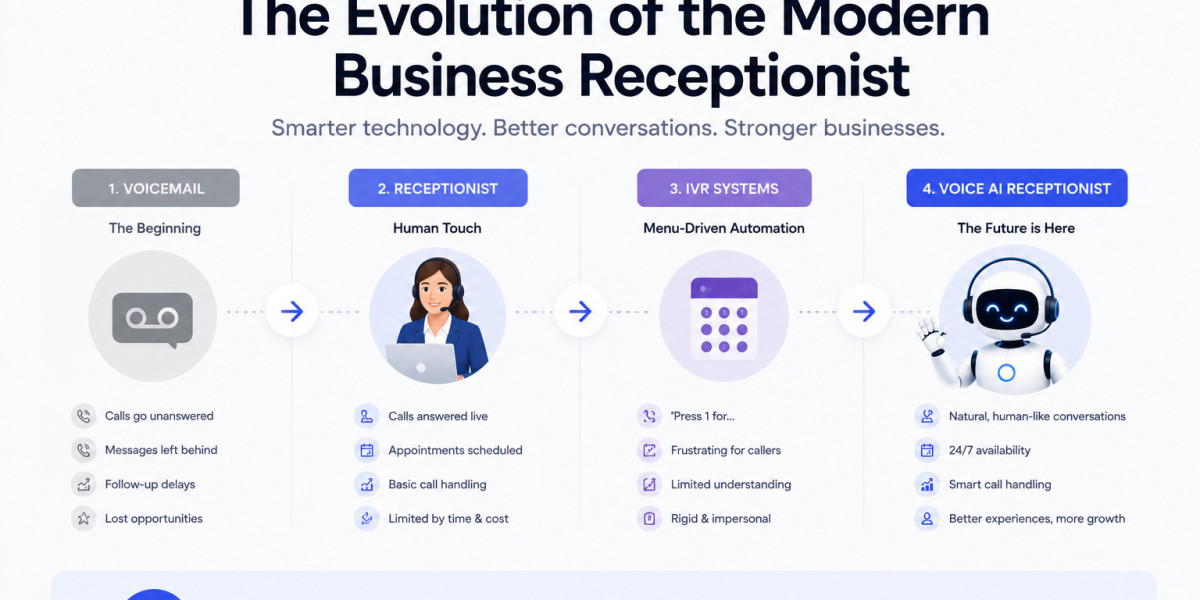

Business communication has changed dramatically over the past few decades.
There was a time when missed calls automatically meant lost opportunities. Businesses relied heavily on voicemail systems, manual callbacks, and traditional reception desks to manage customer communication. While these systems worked for their time, they often created delays, frustration, and operational inefficiencies.
Today, businesses operate in a completely different environment.
Customers expect instant responses, 24/7 availability, and seamless communication across multiple channels. As customer expectations continue rising, traditional receptionist systems are no longer enough to keep businesses competitive.
This shift has led to the rise of Voice AI Receptionist intelligent conversational systems capable of answering calls, handling customer inquiries, booking appointments, qualifying leads, and automating business communication in real time.
From simple voicemail systems to advanced AI-powered voice assistants, the modern business receptionist has evolved into a scalable and intelligent communication solution.
In this article, we’ll explore the evolution of business reception technology, the limitations of traditional systems, and how Voice AI is transforming customer communication for modern businesses.
The Early Days of Business Communication
Before digital communication became mainstream, businesses relied entirely on human receptionists and office staff to manage incoming calls.
Receptionists handled tasks such as:
Answering customer inquiries
Routing calls
Scheduling appointments
Taking messages
Managing front-desk operations
While effective, this approach came with limitations.
Businesses could only respond during office hours, and missed calls often resulted in lost customers or delayed communication.
As businesses grew, managing higher call volumes became increasingly difficult.
The Rise of Voicemail Systems
Voicemail systems became widely adopted as businesses searched for ways to handle calls outside office hours.
Voicemail offered several advantages at the time:
Businesses could receive messages after hours
Customers could leave inquiries anytime
Staff could return calls later
Communication became more organized
For years, voicemail became a standard feature of business communication.
However, voicemail also introduced major problems.
Customers often disliked:
Long wait times for callbacks
Endless voicemail menus
Lack of immediate assistance
Delayed issue resolution
For businesses, delayed responses frequently resulted in:
Lost leads
Missed appointments
Lower customer satisfaction
Reduced conversion opportunities
As customer expectations evolved, voicemail systems started feeling outdated and inefficient.
The Shift Toward Digital Communication
The growth of the internet, smartphones, and cloud communication platforms changed how businesses interacted with customers.
Consumers began expecting:
Faster responses
Instant support
Omnichannel communication
Personalized experiences
Real-time assistance
Businesses responded by adopting tools like:
Live chat systems
CRM platforms
Automated messaging
Cloud phone systems
Chatbots
While these technologies improved accessibility, many businesses still struggled with high call volumes and manual customer communication processes.
Traditional receptionist teams remained overloaded, especially during peak hours.
This created a growing demand for smarter automation solutions.
The Emergence of Voice AI Technology
Recent advancements in artificial intelligence and natural language processing (NLP) transformed what automated communication systems could achieve.
Unlike traditional IVR systems or voicemail menus, Voice AI technology can:
Understand natural speech
Recognize customer intent
Respond conversationally
Handle real-time interactions
Automate complex workflows
This marked the beginning of the AI receptionist era.
Modern Voice AI receptionists can communicate with customers almost like human agents while operating continuously without fatigue or delays.
Businesses quickly realized the potential of Voice AI for improving efficiency and customer experience.
What Is a Voice AI Receptionist?
A Voice AI receptionist is an AI-powered virtual assistant designed to manage customer communication through natural voice conversations.
These systems use conversational AI, speech recognition, and machine learning to automate front-desk interactions.
Voice AI receptionists can:
Answer incoming calls instantly
Schedule appointments
Route calls intelligently
Capture customer information
Respond to FAQs
Qualify leads
Send reminders
Escalate complex cases to human teams
Many platforms also integrate with:
CRM systems
Calendars
Scheduling software
Customer support tools
Messaging platforms
This creates a centralized and automated communication experience.
Why Businesses Are Replacing Traditional Reception Systems
Businesses are moving away from voicemail and manual call handling because modern customers expect faster and more efficient communication.
Here’s why Voice AI is becoming the preferred solution.
1. Customers Expect Instant Responses
Today’s consumers don’t want to wait hours for callbacks or navigate complicated voicemail systems.
AI Call Centre answer calls immediately and provide real-time assistance.
This helps businesses:
Reduce response times
Improve customer satisfaction
Capture leads faster
Reduce abandoned calls
Speed has become a major competitive advantage.
2. Businesses Need 24/7 Availability
Traditional reception desks only operate during business hours.
Voice AI receptionists work continuously, allowing businesses to remain available:
After hours
On weekends
During holidays
During peak call periods
This ensures businesses never miss important customer interactions.
3. Scaling Customer Communication Is Expensive
Hiring and managing large receptionist teams can become costly as businesses grow.
Operational costs may include:
Salaries
Training
Overtime
Staffing management
Call overflow handling
Voice AI allows businesses to scale communication without proportionally increasing staffing costs.
AI systems can handle multiple conversations simultaneously while maintaining consistency.
4. Customers Prefer Faster Self-Service Options
Modern customers increasingly prefer quick and convenient support experiences.
Voice AI receptionists provide:
Immediate answers
Automated scheduling
Faster issue resolution
Efficient call routing
This improves the overall customer experience while reducing front-desk workload.
Industries Leading Voice AI Adoption
Voice AI receptionists are rapidly transforming communication across multiple industries.
Healthcare and Dental Clinics
Healthcare providers use Voice AI to automate:
Appointment scheduling
Patient reminders
Call handling
FAQ responses
Front desk communication
This reduces administrative pressure while improving patient engagement.
Real Estate Businesses
Real estate agencies use Voice AI to:
Capture leads
Schedule property tours
Answer listing inquiries
Qualify prospects
Improve response times
Fast communication often leads to higher conversion opportunities.
Home Service Businesses
HVAC, plumbing, cleaning, and repair businesses frequently miss calls while teams are in the field.
Voice AI receptionists ensure every customer inquiry is answered and routed properly.
Legal Firms
Law firms use Voice AI systems to automate:
Client intake
Consultation booking
Call routing
Basic inquiry handling
This improves operational efficiency while reducing administrative workload.
Voice AI Supports Human Teams Instead of Replacing Them
One of the biggest misconceptions about AI receptionists is that they completely replace human employees.
In reality, most businesses use Voice AI to support human teams.
AI handles repetitive communication tasks while employees focus on:
Complex customer interactions
Relationship management
Sales conversations
Strategic operations
This creates more efficient and productive workflows.
The Future of Business Reception Is AI-Powered
Voice AI technology continues advancing rapidly.
Future AI receptionists are expected to become even more:
Human-like
Personalized
Intelligent
Multilingual
Predictive
Integrated with business systems
As AI improves, businesses will increasingly rely on Voice AI to manage customer communication at scale.
Traditional voicemail systems are quickly becoming outdated in a world driven by instant communication and automation.
Why Businesses Are Embracing Voice AI Now
Businesses today need communication systems that are:
Fast
Scalable
Cost-efficient
Always available
Customer-focused
Voice AI receptionists provide all of these advantages while improving operational efficiency and customer satisfaction.
Companies that adopt AI-powered communication systems early are gaining a measurable competitive edge in customer service and business scalability.
Ready to Upgrade from Voicemail to Voice AI?
Modern businesses can no longer rely on outdated voicemail systems and slow communication workflows.
Voice AI receptionists help businesses automate customer interactions, improve response times, reduce missed opportunities, and deliver better customer experiences around the clock.
Whether you want to improve appointment scheduling, streamline support, or scale customer communication more efficiently, Voice AI technology can help your business stay competitive in the modern digital landscape.







