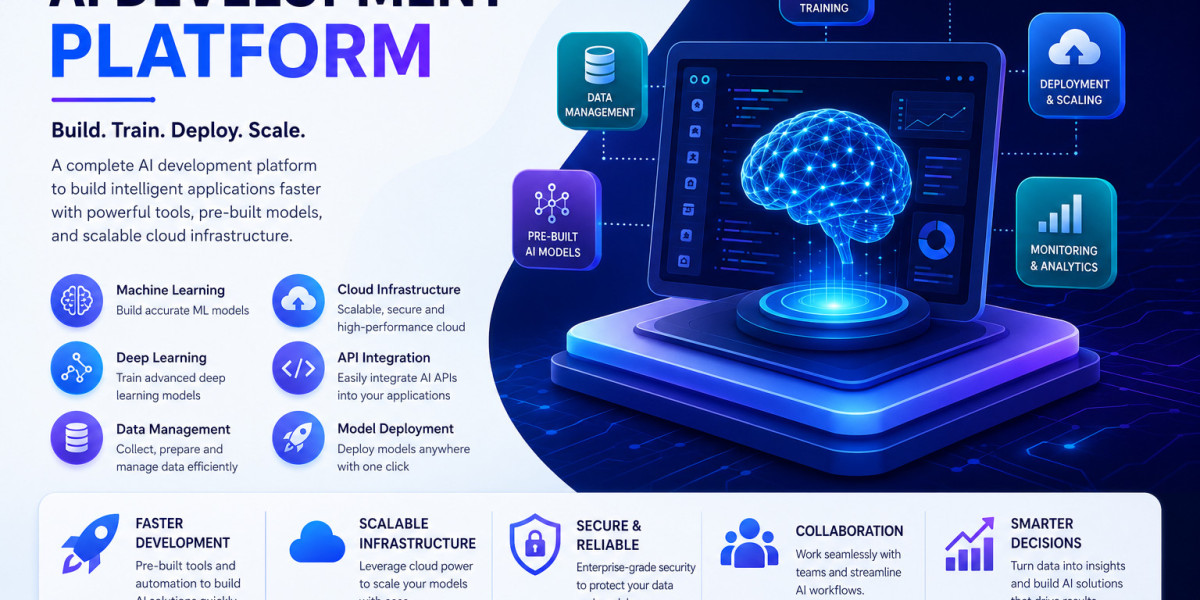

AI Development Platform: Build Smarter AI Solutions
Introduction
Artificial Intelligence (AI) has become one of the biggest drivers of digital transformation across industries. From healthcare and finance to eCommerce and manufacturing, organizations are adopting AI to automate tasks, improve decision-making, and deliver better customer experiences. However, building intelligent applications from scratch can be challenging without the right tools.
An AI Development Platform simplifies the entire AI lifecycle by providing developers, data scientists, and businesses with everything they need in one place. These platforms include tools for collecting data, training machine learning models, deploying AI applications, monitoring performance, and scaling projects efficiently.
In 2026, AI development platforms are more powerful than ever. They combine automation, cloud computing, large language models (LLMs), and no-code capabilities, making AI accessible to businesses of all sizes.
What Is an AI Development Platform?
An AI Development Platform is a software environment that enables users to design, develop, train, test, deploy, and manage artificial intelligence applications. Instead of building every AI component manually, developers can use built-in tools and frameworks to accelerate development.
Most modern AI platforms support:
- Machine Learning (ML)
- Deep Learning
- Natural Language Processing (NLP)
- Computer Vision
- Predictive Analytics
- Generative AI
- AI Chatbots
- Large Language Models (LLMs)
These platforms reduce development time while improving accuracy, security, and scalability.
Key Features of an AI Development Platform
1. Data Management
AI models require high-quality data. A reliable platform provides tools for collecting, cleaning, labeling, and storing datasets efficiently.
2. Model Training
Developers can train machine learning models using built-in frameworks like TensorFlow, PyTorch, and Scikit-learn while utilizing cloud GPUs for faster processing.
3. Automated Machine Learning (AutoML)
AutoML helps users create accurate AI models without writing complex code. It automatically selects algorithms, tunes hyperparameters, and evaluates performance.
4. Model Deployment
Once a model is trained, it can be deployed through APIs, mobile apps, websites, or cloud services with minimal effort.
5. Performance Monitoring
Modern platforms continuously monitor AI performance, detect model drift, and recommend updates to maintain high accuracy.
6. Security and Compliance
Leading AI development platforms include enterprise-grade security, encryption, user access control, and compliance with global privacy standards.
Benefits of Using an AI Development Platform
Faster Development
Pre-built libraries, templates, and automation significantly reduce development time.
Lower Costs
Businesses save money by eliminating the need to build complex AI infrastructure from scratch.
Improved Accuracy
Built-in optimization tools help developers create more reliable and accurate AI models.
Scalability
Cloud-based AI platforms can easily handle growing datasets and increasing workloads.
Better Collaboration
Teams can collaborate through shared workspaces, version control, and centralized project management.
Easier Maintenance
Automatic monitoring and updates simplify long-term AI management.
Popular AI Development Platforms in 2026
Several platforms dominate the AI industry because of their reliability and powerful capabilities.
Microsoft Azure AI
Azure AI provides enterprise-grade AI services, cognitive APIs, machine learning tools, and seamless cloud integration.
Google Vertex AI
Google's platform offers advanced machine learning workflows, AutoML, generative AI models, and powerful cloud infrastructure.
Amazon SageMaker
Amazon SageMaker allows developers to build, train, deploy, and monitor machine learning models at scale.
IBM Watsonx
IBM focuses on enterprise AI with trusted governance, automation, and secure AI deployment.
OpenAI Platform
OpenAI provides access to advanced language models, image generation, AI assistants, and developer APIs for intelligent applications.
Industries Using AI Development Platforms
AI platforms are transforming nearly every sector.
Healthcare
Doctors use AI for disease prediction, medical imaging, patient monitoring, and personalized treatment recommendations.
Finance
Banks detect fraud, automate customer service, analyze investments, and improve risk management.
Retail
Retailers personalize shopping experiences, optimize inventory, forecast demand, and recommend products.
Manufacturing
Factories use predictive maintenance, quality inspection, robotics, and supply chain optimization.
Education
Educational platforms deliver personalized learning, AI tutors, automated grading, and intelligent content recommendations.
How to Choose the Right AI Development Platform
Selecting the right platform depends on your business goals.
Consider the following factors:
- Ease of use
- Cloud compatibility
- AI model support
- Pricing structure
- Scalability
- Security features
- Integration capabilities
- Documentation and community support
- API availability
- Customer support
Testing multiple platforms before making a long-term investment is always recommended.
AI Development Platform Trends in 2026
The AI industry continues evolving rapidly.
Generative AI
Businesses increasingly use generative AI to create text, images, videos, code, and marketing content.
AI Agents
Autonomous AI agents can complete complex workflows with minimal human intervention.
No-Code AI
No-code platforms enable business users to build AI applications without programming knowledge.
Edge AI
AI models now process data directly on devices, reducing latency and improving privacy.
Responsible AI
Organizations focus on fairness, transparency, explainability, and ethical AI development.
Multimodal AI
Modern platforms can understand text, images, audio, and video simultaneously, enabling smarter applications.
Best Practices for AI Development
To maximize AI project success:
- Start with high-quality data.
- Define clear business objectives.
- Continuously monitor model performance.
- Retrain models regularly.
- Prioritize security and privacy.
- Test AI before deployment.
- Document every stage of development.
- Keep human oversight for critical decisions.
Following these practices ensures long-term AI success.
Future of AI Development Platforms
The future looks incredibly promising. AI development platforms will become even more intelligent, automated, and accessible. Businesses will increasingly rely on AI assistants to write code, optimize models, generate reports, and automate workflows.
As quantum computing, advanced GPUs, and large language models continue to evolve, AI platforms will become faster, more accurate, and easier to use. Even small businesses will be able to deploy enterprise-grade AI solutions without requiring massive technical teams.
Organizations that invest in AI today will gain a significant competitive advantage in the coming years.
Conclusion
An AI Development Platform is no longer just a tool for data scientists—it has become a strategic asset for businesses seeking innovation, automation, and growth. By offering integrated tools for data management, model training, deployment, and monitoring, these platforms simplify the AI development process while reducing costs and improving efficiency.
Whether you're building intelligent chatbots, predictive analytics systems, recommendation engines, or generative AI applications, choosing the right platform can accelerate development and deliver better business outcomes. As AI technology continues to advance throughout 2026 and beyond, adopting a modern AI Development Platform will be essential for staying competitive in an increasingly digital world.







