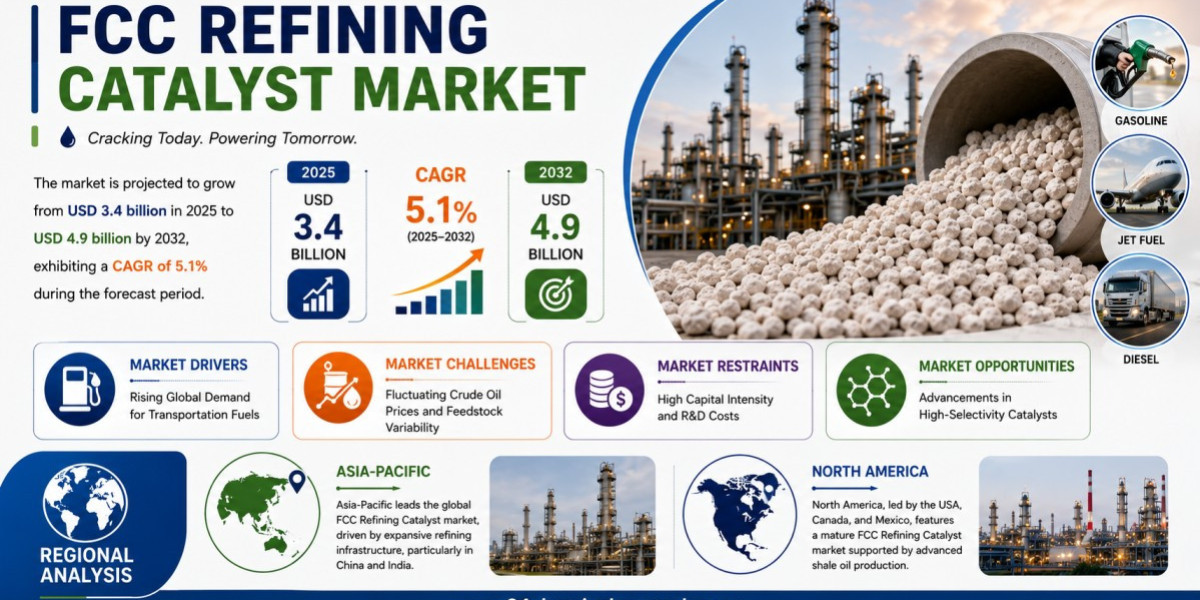

Global FCC Refining Catalyst market size was valued at USD 3.2 billion in 2024. The market is projected to grow from USD 3.4 billion in 2025 to USD 4.9 billion by 2032, exhibiting a CAGR of 5.1% during the forecast period.
Fluid Catalytic Cracking (FCC) Refining Catalysts are essential substances used in the FCC process to break down large, heavy hydrocarbon molecules in petroleum crude oil into valuable, lighter products like gasoline, diesel, and propylene. These catalysts, typically composed of zeolites in a matrix, facilitate complex chemical reactions at high temperatures, significantly improving the yield and quality of fuels and petrochemical feedstocks. The market's growth is primarily driven by the increasing global demand for transportation fuels and the continuous need to process heavier and more sour crude oil feedstocks, with stringent environmental regulations mandating cleaner fuels with lower sulfur content compelling refineries to adopt advanced catalyst formulations for gasoline sulfur reduction.
Download FREE Sample Report: https://www.24chemicalresearch.com/download-sample/267049/global-fcc-refining-catalyst-market
Market Overview & Regional Analysis
Asia-Pacific leads the global FCC Refining Catalyst market, driven by expansive refining infrastructure, particularly in China and India. The region's dominance stems from surging demand for transportation fuels amid rapid industrialization, urbanization, and a burgeoning vehicle population. Major national oil companies like Sinopec and CNPC play pivotal roles, investing heavily in refinery expansions and catalyst technologies to optimize fluid catalytic cracking processes for higher yields of gasoline and olefins. Government initiatives promote energy security and downstream petrochemical integration, fostering innovation in catalyst formulations tailored for heavy residue feedstocks prevalent in local crudes. The presence of domestic manufacturers such as Hcpect, Yueyang Sciensun Chemical, and Rezel Catalysts Corporation enhances supply chain resilience and cost competitiveness.
North America, led by the USA, Canada, and Mexico, features a mature FCC Refining Catalyst market supported by advanced shale oil production. Refineries utilize high-complexity FCC units to process heavy crudes, with emphasis on maximum middle distillates and bottoms conversion catalysts. Leading global players Grace Catalysts Technologies and Albemarle drive innovation, offering proprietary technologies for gasoline sulfur reduction amid stringent clean fuel mandates. The region's focus on operational efficiency and yield optimization sustains steady demand, while environmental pressures encourage low-emission formulations, positioning North America as a hub for technological advancements influencing global standards.
Key Market Drivers and Opportunities
The market is primarily driven by rising global demand for transportation fuels and refinery capacity expansions and modernization. The unrelenting demand for high-octane gasoline and diesel, core outputs from fluid catalytic cracking units in refineries, is propelled by surging vehicle ownership, particularly in emerging economies like India and Southeast Asia. Major oil companies are investing heavily in refinery upgrades to handle diverse crudes, boosting FCC catalyst consumption, with over 15 million barrels per day of new capacity expected by 2030 directly fueling catalyst demand. Technological innovations in zeolite-based catalysts improve propylene yields by up to 10%, supporting petrochemical integration, while the push for IMO 2020-compliant low-sulfur fuels accelerates catalyst adoption in residue FCC units.
Significant opportunities lie in advancements in high-selectivity catalysts and Asia-Pacific's refining boom. Breakthroughs in nano-engineered catalysts promise 15% higher light olefin yields, opening doors for propane dehydrogenation integration, with FCC units evolving into profit centers, especially in propylene-short regions like China. Asia-Pacific's refining boom, with 5 million bpd added by 2027, creates vast opportunities for tailored catalysts, while digital twins optimize FCC performance in real-time, reducing downtime by 25%. Shifting to renewable feedstocks offers another avenue; bio-cracking catalysts handle vegetable oils efficiently, aligning with net-zero goals and potentially capturing 10% market share by 2035. Aftermarket services like catalyst regeneration gain traction, extending life by 50% and slashing costs.
Challenges & Restraints
The market faces considerable challenges, primarily from fluctuating crude oil prices and feedstock variability, and environmental compliance pressures. Oil price swings disrupt refinery operations, forcing FCC units to process inconsistent heavy feeds that degrade catalyst performance, with refiners facing yield losses of 2-5% when handling high-contaminant crudes. Stricter emissions standards worldwide demand low-emission catalysts, but retrofitting FCC regenerators costs millions, with Europe leading on CO2 capture mandates while Asia struggles with enforcement, leading to uneven market dynamics. Supply chain disruptions, exacerbated by geopolitical tensions, delay catalyst deliveries, impacting 20% of global refineries annually.
Key restraints include high capital intensity and R&D costs, and dependency on rare earth elements. Creating a single zeolite matrix can cost over $50 million, limiting entry for new competitors and favoring incumbents like established chemical giants, with refiners hesitating on frequent unit shutdowns for catalyst changes. Dependency on rare earth elements for high-performance catalysts exposes the market to supply shortages, with price hikes of 30% in recent years straining budgets, while recycling efforts remain underdeveloped at under 10% recovery rates globally. Regulatory hurdles with EPA and EU norms mandating reduced metals emissions prolong market entry by 18-24 months, and intellectual property battles over proprietary additives stifle innovation.
Market Segmentation by Type
Gasoline Sulfur Reduction
Maximum Light Olefins
Maximum Middle Distillates
Maximum Bottoms Conversion
Others
Download FREE Sample Report: https://www.24chemicalresearch.com/download-sample/267049/global-fcc-refining-catalyst-market
Market Segmentation by Application
Oil Refineries
Chemical Industry
Others
Market Segmentation and Key Players
Grace Catalysts Technologies (USA)
BASF (Germany)
Albemarle (USA)
JGC C&C (Japan)
Sinopec (China)
CNPC (China)
Hcpect (China)
Yueyang Sciensun Chemical (China)
Rezel Catalysts Corporation (Taiwan)
Report Scope
This report presents a comprehensive analysis of the global and regional markets for FCC Refining Catalyst, covering the period from 2025 to 2032. It includes detailed insights into the current market status and outlook across various regions and countries, with specific focus on:
Sales, sales volume, and revenue forecasts
Detailed segmentation by type and application
In addition, the report offers in-depth profiles of key industry players, including:
Company profiles
Product specifications
Production capacity and sales
Revenue, pricing, gross margins
Sales performance
It further examines the competitive landscape, highlighting the major vendors and identifying the critical factors expected to challenge market growth. As part of this research, we surveyed FCC Refining Catalyst companies and industry experts. The survey covered various aspects, including:
Revenue and demand trends
Product types and recent developments
Strategic plans and market drivers
Industry challenges, obstacles, and potential risks
Get Full Report Here: https://www.24chemicalresearch.com/reports/267049/global-fcc-refining-catalyst-market
About 24chemicalresearch
Founded in 2015, 24chemicalresearch has rapidly established itself as a leader in chemical market intelligence, serving clients including over 30 Fortune 500 companies. We provide data-driven insights through rigorous research methodologies, addressing key industry factors such as government policy, emerging technologies, and competitive landscapes.
Plant-level capacity tracking
Real-time price monitoring
Techno-economic feasibility studies
With a dedicated team of researchers possessing over a decade of experience, we focus on delivering actionable, timely, and high-quality reports to help clients achieve their strategic goals. Our mission is to be the most trusted resource for market insights in the chemical and materials industries.
Asia: +91 9169162030
Website: https://www.24chemicalresearch.com/